ER Status, PAM50, ER IHC, and H&E Images in Breast Cancer
This post is an educational overview of pathology and biomarker concepts in breast cancer, not medical advice.
If you are working on ER status and PAM50 subtype using ER immunohistochemistry (IHC) and H&E whole-slide images, you are operating at the intersection of three different views of the same tumor:
- morphology on H&E,
- protein expression on IHC,
- gene-expression programs on PAM50.
That is exactly why the problem is interesting. These three views are strongly related, but they are not identical. A breast tumor can look morphologically luminal on H&E, be ER positive by IHC, and still differ biologically from another ER-positive tumor when measured at the RNA level. The mismatch between these layers is part of what makes breast cancer clinically and computationally challenging.
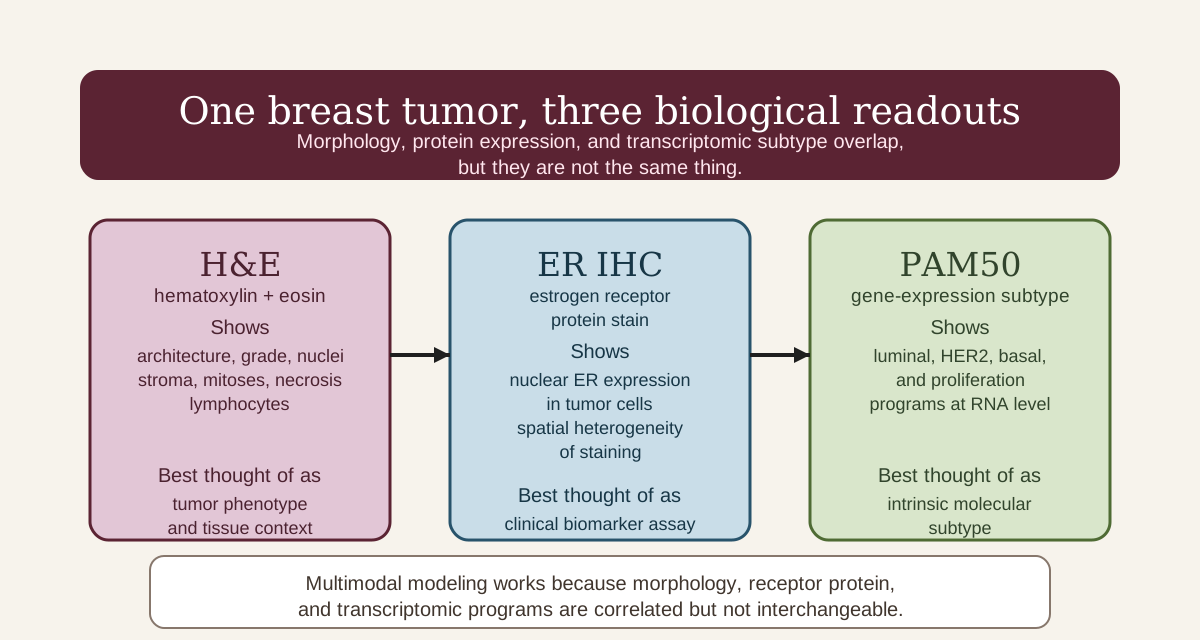
Figure 1. H&E, ER IHC, and PAM50 are not redundant measurements. They describe morphology, receptor protein, and gene-expression state, respectively.
1. Why breast cancer needs more than one label
Breast cancer is not a single disease. Tumors differ in growth rate, histologic grade, likelihood of recurrence, and response to endocrine therapy, chemotherapy, and HER2-targeted therapy. This is why clinical pathology uses several layers of information at once:
- routine histology,
- biomarker stains such as ER, PR, and HER2,
- and, in selected settings, multigene assays such as PAM50/Prosigna.
The National Cancer Institute emphasizes that biomarker tests such as ER, PR, HER2, and Ki-67 help estimate how a tumor may behave and which treatments may work best. In other words, the pathology workflow is already multimodal before any machine-learning model is built.
2. What ER status actually means
ER status refers to whether breast cancer cells express the estrogen receptor. This matters because estrogen signaling can drive tumor-cell growth in a large fraction of breast cancers. When the tumor is ER positive, endocrine therapy may be effective. When it is ER negative, endocrine therapy is usually much less helpful.
The clinically important point is that ER is not only a biological feature; it is a treatment-linked biomarker. According to the ASCO/CAP guideline update, validated immunohistochemistry is the standard method for ER testing in invasive breast cancer. The same guideline states:
- tumors with 1% to 100% ER-positive tumor nuclei are interpreted as ER positive;
- tumors with 1% to 10% staining should be flagged as ER Low Positive because endocrine benefit may be less certain;
- tumors with <1% positive tumor nuclei are interpreted as ER negative.
That thresholding matters for model design. If you train a classifier on ER labels, you are not predicting an abstract biology score. You are trying to approximate a clinically defined assay whose output has direct therapeutic implications.
3. What H&E images tell us
H&E stands for hematoxylin and eosin, the standard stain used in surgical pathology.
- hematoxylin colors nuclei blue to purple;
- eosin colors cytoplasm, collagen, and extracellular matrix pink.
An H&E slide does not directly measure ER protein or RNA expression. What it gives you is something different and still extremely valuable: the tumor’s morphologic phenotype.
On H&E, pathologists evaluate features such as:
- histologic type, for example ductal versus lobular patterns;
- tubule formation and glandular architecture;
- nuclear pleomorphism;
- mitotic activity;
- necrosis;
- stromal composition;
- tumor-infiltrating lymphocytes and other microenvironmental context.
These are not trivial details. Histologic grade and morphology are already associated with prognosis in breast cancer, and computational pathology studies have shown that H&E images contain measurable signals related to biomarker status, tumor aggressiveness, and outcome.
In short:
- H&E is phenotype-rich
- but not a direct receptor assay
That distinction is essential. If a model predicts ER status from H&E, it is inferring receptor state indirectly from morphology and tissue context.
4. What ER IHC adds beyond H&E
ER IHC is much closer to the clinical label than H&E because it stains for the receptor protein itself. In a typical ER IHC slide, positive tumor-cell nuclei are highlighted, allowing the pathologist to estimate:
- whether tumor nuclei stain at all,
- what fraction of nuclei are positive,
- and whether staining is strong, weak, diffuse, or heterogeneous.
Biologically, ER IHC sits between H&E and PAM50:
- it is more specific than H&E because it directly measures a single biomarker;
- but it is narrower than PAM50 because it does not capture the entire luminal/HER2/basal transcriptional program.
That is why ER IHC is such a useful companion modality for H&E. H&E gives broad tissue context; ER IHC gives spatially localized receptor expression. Together they form a plausible multimodal basis for predicting both ER status and more complex downstream labels such as intrinsic subtype.
5. What PAM50 is and why it is different
PAM50 is a gene-expression classifier based on the expression of 50 genes. In the canonical intrinsic-subtype framework, it is used to assign breast tumors to categories such as:
- Luminal A
- Luminal B
- HER2-enriched
- Basal-like
- and, depending on implementation and reporting, sometimes Normal-like
Historically, PAM50 emerged from the breast-cancer intrinsic-subtype work led by Charles Perou and colleagues, and the clinically deployable 50-gene assay was developed in work closely associated with UNC Chapel Hill, where Perou has been a leading figure in molecular breast-cancer classification.
The important point is that PAM50 is not an IHC panel. It is not just ER, PR, and HER2 with a different name. It is an RNA-level summary of underlying tumor biology.
The PAM50/Prosigna literature shows two reasons it matters:
- it captures intrinsic subtype biology using a curated gene-expression signature rather than a small protein panel;
- it improves risk stratification, especially inside clinically “luminal” disease, where ER-positive tumors can still behave very differently.
That second point is clinically important. In a population-based survivor cohort, PAM50 was reported to distinguish low-risk Luminal A from higher-risk Luminal B better than routine IHC markers and tumor grade alone. This is exactly the kind of signal that motivates computational work beyond a simple ER-positive versus ER-negative split.
6. ER status and PAM50 subtype are correlated, but they are not the same
This is the relationship that most people oversimplify.
The broad pattern
At a high level, the usual associations are:
| Intrinsic subtype | Typical ER pattern | Typical biology |
|---|---|---|
| Luminal A | usually ER positive | strong luminal program, lower proliferation, often better prognosis |
| Luminal B | often ER positive | luminal but more proliferative and generally higher risk than luminal A |
| HER2-enriched | ER positive or ER negative | strong HER2/proliferation program, not identical to clinical HER2 positivity |
| Basal-like | usually ER negative | highly proliferative, often overlaps with triple-negative disease |
| Normal-like | variable / less emphasized | can reflect sample composition and is often interpreted cautiously |
So yes, ER positivity strongly points toward luminal biology, especially luminal A or luminal B. But that is only the first approximation.
Why they are not interchangeable
PAM50 discordance studies make the limitation clear:
- not all ER-positive tumors are luminal A;
- some ER-positive tumors are luminal B;
- some clinically HR-positive tumors can even map to non-luminal intrinsic states;
- HER2-enriched is not equivalent to “HER2 positive by IHC/FISH”;
- basal-like strongly overlaps with triple-negative disease, but the match is not perfect.
One particularly important nuance is that PAM50 can re-stratify ER-positive disease. Two tumors may both be ER positive by IHC, yet one may look more like luminal A and another more like luminal B or HER2-enriched at the transcriptomic level. That is part of why ER alone is insufficient as a full description of breast-cancer biology.
7. How these phenotypes influence treatment
The reason these phenotypes matter is not just descriptive pathology. They influence treatment selection, expected benefit, and risk stratification.
7.1 ER-positive disease and endocrine therapy
If a tumor is ER positive, estrogen signaling is likely contributing to tumor biology, so endocrine therapy becomes relevant. Depending on menopausal status and clinical setting, this can include:
- tamoxifen,
- aromatase inhibitors,
- ovarian suppression,
- and in some settings combinations with targeted agents such as CDK4/6 inhibitors.
This is why ER is so clinically central. It is not just prognostic; it is directly predictive of likely endocrine responsiveness. That is also why the ASCO/CAP ER guideline is so careful about assay quality and positivity thresholds.
7.2 Luminal A versus Luminal B
Both Luminal A and Luminal B are usually ER positive, but they often differ in treatment intensity and recurrence risk.
- Luminal A tumors are typically more endocrine-responsive, less proliferative, and often associated with better prognosis.
- Luminal B tumors are also commonly hormone-receptor positive, but they tend to be more proliferative and higher risk.
Clinically, that often means Luminal B disease is more likely to trigger discussion of additional systemic therapy, including chemotherapy, than classic low-risk Luminal A disease.
That is one of the most important reasons PAM50-like subtyping matters: it can refine the broad category of “ER-positive breast cancer” into biologically and therapeutically different groups.
7.3 HER2-enriched biology
The HER2-enriched intrinsic subtype reflects a transcriptional program, not simply HER2 positivity by routine clinical testing. Still, in practice HER2 pathway activation matters because tumors with true HER2-positive disease may benefit substantially from HER2-targeted therapy, such as trastuzumab and related anti-HER2 agents.
The subtle point is this:
- clinical HER2 status is determined by validated HER2 testing,
- whereas HER2-enriched PAM50 subtype is an RNA-defined intrinsic state.
These overlap, but they are not identical. From a modeling perspective, this means image-based subtype prediction may capture HER2-related biology even when the mapping to clinical HER2 treatment eligibility is not one-to-one.
7.4 Basal-like and triple-negative patterns
Basal-like tumors often overlap with triple-negative breast cancer (TNBC), meaning lack of ER, PR, and HER2 expression. These tumors are often more proliferative and are generally not candidates for endocrine therapy or anti-HER2 therapy.
That shifts treatment reliance more toward:
- chemotherapy,
- and, depending on the exact clinical context, other systemic strategies guided by additional biomarkers and staging.
This is another reason morphology matters. Basal-like and other aggressive phenotypes may display recognizable H&E patterns such as higher grade, conspicuous mitoses, necrosis, and strong stromal or immune reactions.
7.5 Why treatment relevance matters for your modeling task
If your model predicts:
- ER status, it is approximating a biomarker with direct treatment consequences;
- PAM50 subtype, it is approximating a richer molecular phenotype that can refine prognosis and potentially explain why tumors with similar routine biomarkers may still behave differently.
That is why this is not just an image-classification exercise. It is a problem about linking tissue phenotype to therapeutically meaningful biology.
| Phenotype / biomarker pattern | Typical treatment implication |
|---|---|
| ER positive | endocrine therapy becomes relevant |
| ER low positive | endocrine benefit may be less certain; interpretation is more cautious |
| Luminal A | often more endocrine-sensitive and lower risk |
| Luminal B | often endocrine-sensitive but higher risk; chemotherapy is more often considered |
| HER2-positive clinical disease / HER2-driven biology | anti-HER2 therapy may be relevant |
| Basal-like / triple-negative pattern | endocrine and HER2-targeted therapy usually do not apply; treatment often leans more on chemotherapy-based strategies |
8. Why H&E and ER IHC make sense together for this problem
If your task is to predict ER status or PAM50 subtype, combining H&E with ER IHC is biologically coherent.
H&E contributes morphology and context
H&E may capture:
- tumor grade,
- gland formation,
- nuclear atypia,
- mitotic density,
- stromal reaction,
- immune infiltration,
- necrosis and other context associated with aggressive biology.
These features often correlate with subtype. For example, luminal A tumors are more often lower grade, whereas basal-like and many HER2-enriched tumors tend to be more proliferative and morphologically aggressive.
ER IHC contributes a direct biomarker signal
ER IHC contributes:
- direct nuclear receptor expression,
- intensity and percentage of positive cells,
- spatial heterogeneity within the tumor.
This is highly informative for separating luminal from non-luminal biology, especially when the model must distinguish tumors that may look somewhat similar on routine H&E alone.
Multimodal learning mirrors pathology workflow
There is a practical reason this setup is attractive in computational pathology. A large deep-learning study showed that paired H&E and IHC serial sections can be aligned to obtain precise regional labels and learn biomarker-associated morphology on H&E. That is conceptually close to the kind of pipeline you are describing: one modality provides the clinical biomarker supervision, while the other provides rich morphological context.
From a modeling perspective, the combination is appealing because:
- H&E contains broad but indirect information;
- ER IHC contains narrow but direct information;
- PAM50 provides a deeper RNA-level target that partly overlaps with both.
9. Why this is still a hard problem
Even with both H&E and ER IHC, PAM50 prediction remains nontrivial.
8.1 PAM50 is an RNA-level assay
PAM50 reflects expression programs involving luminal genes, proliferation genes, HER2-related genes, and basal-like programs. ER IHC only directly measures one protein marker. So a model can gain a lot from ER IHC, but it still has to infer additional biology not directly stained on the slide.
8.2 Intratumoral heterogeneity
A tumor can contain regions with different morphology, different receptor expression, and different microenvironmental context. Bulk RNA assays collapse those signals into one sample-level label. Whole-slide images preserve spatial heterogeneity. That mismatch creates label noise.
8.3 Serial-section mismatch
In paired H&E and IHC workflows, the two slides are adjacent sections, not the exact same physical section. Most tissue structures line up well, but local differences still exist. Any patch-level model must account for imperfect alignment.
8.4 Clinical labels are not purely biological labels
ER status is measured under a clinical reporting framework with thresholds and quality-control rules. PAM50 depends on assay platform and reporting conventions. So the model is learning not just “biology in the abstract,” but biology filtered through specific assay definitions.
10. What this means biologically
The most useful way to summarize the relationship is:
| Layer | What it measures | Strength | Limitation |
|---|---|---|---|
| H&E | morphology and tissue architecture | rich phenotype and microenvironment | indirect for receptor state |
| ER IHC | ER protein in tumor nuclei | direct clinical biomarker | narrow view of biology |
| PAM50 | tumor gene-expression program | intrinsic subtype and prognostic information | no direct spatial context |
This table explains why multimodal pathology models are biologically plausible.
- If you want to know what the tumor looks like, H&E is central.
- If you want to know whether estrogen signaling is present, ER IHC is central.
- If you want to know which intrinsic molecular program dominates, PAM50 is central.
No single one of these fully replaces the others.
11. A practical interpretation for your project
If your recent work used ER IHC and H&E images for ER status and PAM50 subtype, the biological rationale is strong:
- ER status prediction is the easier and more direct task because ER IHC closely matches the clinical label.
- PAM50 prediction is harder but more interesting because it asks whether morphology plus receptor protein can recover deeper molecular subtype information.
- The expected gains from multimodality come from combining:
- H&E-derived architectural and microenvironmental cues,
- ER IHC-derived receptor localization and heterogeneity,
- subtype structure that links luminal biology, proliferation, and HER2/basal programs.
The main caution is that even a strong image model should be viewed as complementary to, not a replacement for, validated clinical biomarker and molecular assays unless it has been rigorously validated for that role.
12. Final takeaway
In breast cancer:
- ER status tells you whether the tumor expresses the estrogen receptor in a clinically meaningful way;
- ER IHC is the standard protein assay used to measure that status on tissue;
- H&E shows the tumor’s morphology and microenvironment;
- PAM50 classifies the tumor’s intrinsic molecular subtype from gene expression.
These measurements are related because they all describe the same tumor, but they operate at different biological layers. That is why the combination of ER IHC + H&E is not redundant. It is a principled multimodal view of breast cancer that can be especially useful when the goal is to bridge routine pathology images and deeper molecular phenotypes such as PAM50 subtype.
Selected References
- National Cancer Institute. Breast Cancer Biomarkers: Hormone Receptors, HER2, and Others
- Allison KH, Hammond MEH, Dowsett M, et al. Estrogen and Progesterone Receptor Testing in Breast Cancer: ASCO/CAP Guideline Update
- Parker JS, Mullins M, Cheang MCU, et al. Supervised Risk Predictor of Breast Cancer Based on Intrinsic Subtypes
- Nielsen TO, Parker JS, Leung S, et al. Development and verification of the PAM50-based Prosigna breast cancer gene signature assay
- Zong Y, Goldstein D, Mirza N, et al. Determining breast cancer biomarker status and associated morphological features using deep learning
- Lodi M, Scheer A, Reix N, et al. Intrinsic subtypes from the PAM50 gene expression assay in a population-based breast cancer survivor cohort
- Maleki Z, Gerber B, Jansen van Vuren P, et al. Discordance between PAM50 intrinsic subtyping and immunohistochemistry in women with breast cancer