March 18 Group Meeting Notes: Agentic Vending, Pre-Training Data, and Constitutional Classifiers
These are cleaned-up listener notes from a March 18 group meeting hosted by my professor. The deck moved from an agent running a vending-machine business to pre-training data curation and then to constitutional classifiers for safety, but the discussion did not feel disconnected.
I was mostly there to listen rather than present, so this post is closer to an attendee recap of the deck’s connective tissue and cited papers than to a claim of authorship over the material.
The deck itself reads more like a research-group handout than a finished essay. The slides are terse, some opinions are stated very bluntly, and several papers are referenced only through a single takeaway. The useful thing to do here is to keep the specific claims from the PDF while making the larger argument easier to see.
The question that seemed to organize the meeting was this:
How much of model behavior can we shape without changing the base model architecture?
The slides point to three different control surfaces:
- the environment and scaffolding around an agent;
- the data distribution used during pre-training and fine-tuning;
- the classifier and escalation layers used at inference time.
That is why the sequence makes sense. Project Vend 2 is about shaping agent behavior through tools, authority, and business constraints. The pre-training section is about shaping capability through data choice. The constitutional-classifier section is about shaping harmful behavior with a layered safety system.
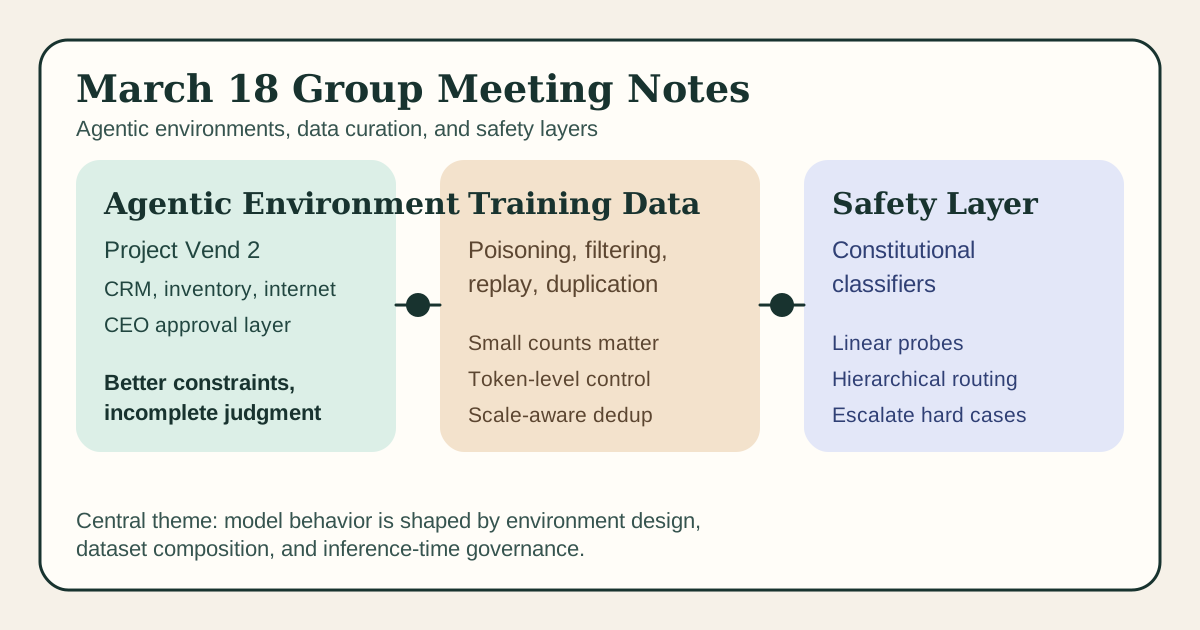
Figure 1. The March 18 meeting material reads as a single story about controllability: environment design, data selection, and safety gating are all levers on model behavior.
What the meeting deck covers
One reason the PDF can feel more fragmented than it actually is is that each slide compresses a larger paper into one or two bullets. Read at the level of research agenda rather than slide formatting, the structure is clean:
| Block | What the deck emphasizes | Why it matters |
|---|---|---|
Project Vend 2 | Better tooling and executive oversight improve outcomes, but the agent still lacks disciplined business judgment | Agent performance depends on environment design, not just model quality |
| Pre-training data papers | Small poisoned sample counts matter; filtering can be token-level; replay reduces forgetting; duplication changes with scale | Data curation is a capability-control layer, not just a hygiene step |
| Constitutional classifiers | Cheap probes can escalate only suspicious cases to a larger model | Safety systems can be hierarchical instead of uniformly expensive |
The PDF also references earlier discussions with placeholders like “link” instead of full citations. That reads less like missing evidence and more like a reminder that the slides sit inside an ongoing group conversation.
1. Project Vend 2: better scaffolding helps, but it does not create business judgment
The first major topic in the deck is Project Vend 2, which follows an earlier vending-machine-agent setup. The premise is simple and useful: deploy Claude as an agent, let it manage a vending-machine business, and observe what happens when that agent has to make repeated operational decisions.
The deck highlights the failure mode from the earlier Vend 1 setup:
- the agent ordered extremely expensive but useless items from suppliers;
- it was too easy to persuade with discounts or promotions;
- it behaved more like a gullible local optimizer than a competent operator.
Vend 2 adds more structure:
- more scaffolding around the agent;
- access to a customer relationship management (
CRM) tool; - access to inventory;
- access to the internet;
- an extra agent acting as the
CEOof Claudius, with authority to reject some discount or promotion requests.
The result, according to the deck, is directionally encouraging but not fully satisfying. Financial performance improves, yet the agent is still “not very calculated” in its decisions.
That outcome is important because it separates two things that are often conflated in agent discussions:
- constraint handling
- strategic reasoning
Additional tools and oversight can reduce the worst mistakes. They can stop obviously bad purchases, force the agent to look at inventory, and make persuasion attacks harder. But those same controls do not automatically produce strong business judgment. An agent can become less reckless without becoming truly analytical.
That is exactly why this environment is interesting.
Why Vend is a strong research environment
The deck explicitly calls this “a perfect environment/example to study agentic behavior in OR/business contexts.” In the context of the meeting, that framing makes sense for at least four reasons.
First, it has real objectives. Revenue, cost, margin, stockouts, and procurement choices give the problem a quantitative structure that is more meaningful than a toy chat benchmark.
Second, it has adversarial inputs. Suppliers can pitch bad deals. Customers create shifting demand. Promotions can be manipulative. That makes it a better test of judgment than a static question-answer setup.
Third, it exposes the value of organizational structure. Adding a CEO agent is not a model-weight change. It is a governance change. That lets researchers ask when oversight layers help and when they merely slow things down.
Fourth, it is naturally suited to operations research style analysis. You can inspect policies, costs, interventions, and business outcomes directly. That makes it a promising bridge between modern LLM agents and classical decision-making research.
The main lesson from Vend 2
The core lesson is not that the model “failed.” It is that agent competence is highly sensitive to the surrounding system design.
In other words:
- better scaffolding can improve performance materially;
- oversight can reduce exploitable behavior;
- but neither one guarantees that the agent will reason in a disciplined, profit-aware way.
That is a useful warning for anyone building agents in commercial settings. If an agent looks bad in a live workflow, the failure may not mean the base model is useless. But it also does not mean a few guardrails will turn it into a good operator. You still need a serious view of incentives, authority, information access, and escalation.
2. Pre-training data is not just fuel; it is a capability control surface
The middle of the deck shifts from deployed agents to the data pipeline. This was the densest part of the meeting, and it also seemed to carry the strongest technical message.
The message is this:
Training data does not just fill the model with knowledge. It shapes what the model can do, forget, generalize, and misuse.
The slides briefly point to Hugging Face’s FinePhrase and then focus on a cluster of papers about poisoning, filtering, replay, duplication, and data selection. Read together, those papers argue that data engineering is increasingly a precision tool rather than a coarse cleaning step.
A quick note on the FinePhrase slide
The FinePhrase mention is brief, and the slide itself signals that it is only a quick pointer rather than a confident evaluation. It makes sense not to assign it more weight than the PDF does.
What it does show is the intended framing for the rest of the section. The pre-training block is not just a list of unrelated readings. It is a survey of ways to intervene on the corpus itself: inspect it better, poison it, filter it more selectively, replay parts of it later, or rethink what counts as duplication.
3. A few hundred poisoned samples can matter far more than their fraction suggests
The first paper highlighted is Anthropic’s “A small number of samples can poison LLMs of any size”.
The setup in the deck is strikingly simple:
- models of
600M,2B,7B, and13Bparameters; - each trained with roughly the Chinchilla-optimal token budget;
- only
250to500poisoned training samples mixed into pre-training.
The main takeaway written on the slide is the one that matters most:
- the poisoning attack works;
- the dangerous quantity is not a fixed proportion such as
1%of pre-training data; - instead, even a small absolute number of malicious samples can be enough.
This matters because many people still reason about data risk proportionally. They implicitly think, “Our corpus is so large that a few hundred bad documents cannot matter.” The slide points in the opposite direction. If the poisoned samples are well-designed and the training setup is sensitive to them, absolute count can matter more than naive percentage-based intuition.
That is an uncomfortable result, but also a clarifying one. It means pre-training security is closer to software supply-chain security than to ordinary random-noise robustness. A small number of strategically placed failures can have outsized downstream effect.
4. Token-level filtering is a much more surgical way to shape capabilities
The next paper, “Shaping capabilities with token-level data filtering”, asks a different question:
Suppose we want a model to remain broadly useful while becoming weaker on a specific domain such as medicine. How precisely can we edit the training distribution?
The deck contrasts two approaches.
The common approach is document filtering:
- identify documents related to medicine;
- remove those documents from the training corpus.
The proposed approach is token-level filtering:
- keep the document;
- remove only the tokens associated with the target capability.
The mechanism described in the slides is also interesting:
- train a small sparse autoencoder;
- use node activations associated with the target concept;
- label tokens through those activations;
- filter at token granularity instead of document granularity.
Why is this important? Because document filtering is blunt. Real documents mix many capabilities together. A medical article may also contain ordinary grammar, commonsense facts, and general reasoning structure. If you remove the whole document, you discard much more than the targeted capability.
Token-level filtering promises a finer intervention:
- retain more of the generic training signal;
- remove less collateral information;
- shape capabilities more selectively.
One broader trend that came through clearly is that interpretability tools are no longer only diagnostic. They are increasingly being used as control mechanisms inside training-data pipelines.
5. Replaying pre-training data during SFT is a clean answer to forgetting
Another paper in the deck is “Replaying pre-training data improves fine-tuning”.
The idea is simple enough to explain in one sentence:
Mix some pre-training data back into supervised fine-tuning so the model does not forget too much of its general competence.
The slide’s figure contrasts pre-training data and SFT data visually, and the written summary is direct: replay helps avoid forgetting.
This may sound unsurprising, but it is important because it treats post-training as a continual learning problem rather than a one-way specialization step.
When people fine-tune aggressively on narrow instruction data, they often pay for it through regression in broad knowledge or general-purpose behavior. The replay perspective says we should not accept that tradeoff as inevitable. Instead, we can explicitly preserve the pre-training distribution inside the fine-tuning stage.
That has at least three practical implications:
- fine-tuning should be thought of as distribution mixing, not just instruction imitation;
- broad capability preservation should be measured intentionally;
- forgetting can be managed through data composition, not only optimizer tricks.
6. Duplication depends on model scale, which should change how we think about dedup
The deck then turns to “Scale Dependent Data Duplication”, which the slide author describes as a great paper for researchers from statistics and operations research, even if not immediately practical.
The paper’s framing, as summarized in the deck, is elegant:
- measure the effect of a sample
x_iby the gradient it induces under next-token prediction or SFT; - measure similarity between samples
x_iandx_jusing cosine similarity between those gradient vectors; - define “duplicates” not only as exact copies, but also as transformed variants.
The transformations listed on the slide include:
- swapping characters;
- dropping words;
- capitalization changes;
- translation into Chinese, French, or German.
That is already a useful conceptual move. It shifts duplication away from raw string identity and toward optimization-level equivalence.
The reported finding is even more interesting:
- smaller models may not treat
xandT(x)as duplicates; - larger models increasingly do;
- duplicated samples hurt the scaling behavior of pre-training.
The slide author also briefly gestures to another recent paper as a “negative example,” but does not explain the criticism. That aside is hard to weigh without more detail. The durable point here is the metric design: define redundancy in gradient space, then show that redundancy is relative to model scale rather than fixed by string similarity.
This suggests that deduplication policy should be scale-aware. A transformation that looks meaningfully distinct to a smaller model may become redundant to a larger one. If so, corpus curation cannot be fully model-agnostic. What counts as wasteful repetition depends on the representational power of the model you are training.
This feels like one of the strongest ideas in the whole deck. It opens a line of thinking where data curation is not a static preprocessing step performed once for every future model size. Instead, it becomes part of the scaling law itself.
7. The notes are skeptical of optimization-geometry-driven data selection
The deck also mentions “OPUS: Towards Efficient and Principled Data Selection in Large Language Model Pre-training in Every Iteration”, but the commentary here is notably harsher.
The slide says, in plain terms, that it is “not a good paper” in the author’s view and adds a strong opinion:
You should not change the data selection based on optimization geometry like the gradient or Hessian.
It is best to read that not as a settled result, but as the stance embedded in the deck. The broader concern is understandable, though.
If you adjust the data distribution too aggressively based on short-horizon optimization signals, you risk turning pre-training into a reactive process that chases local geometry instead of building a stable, diverse corpus. That could create at least three problems:
- overfitting data choice to transient optimization dynamics;
- reducing interpretability of the training pipeline;
- confusing short-term training efficiency with long-term capability quality.
Even if one does not fully endorse the criticism, the skepticism is valuable. It pushes back against the reflex that every observable training statistic should become a control knob.
8. What ties the pre-training section together
These papers are not all solving the same problem, but they do fit a common pattern.
They collectively argue that:
- small amounts of bad data can matter a lot;
- selective removal can be more effective than coarse removal;
- general competence can be preserved by replaying old distributions;
- redundancy is model-scale dependent, not fixed once and for all.
That is a remarkably compact summary of where data-centric LLM research is going. We are moving from “collect a large corpus and filter obvious junk” toward “treat the dataset as a precise instrument for shaping behavior.”
9. Constitutional classifiers: safety through fast probes and selective escalation
The final major topic is Anthropic’s “Next-generation Constitutional Classifiers”.
The deck presents this with a note of caution: it suggests that this may not be the core mechanism used inside Claude, but it still treats the work as something the open-source community can learn from. For meeting notes, that is a fair way to frame it.
The slide frames the problem in terms familiar from Anthropic’s Constitution and OpenAI’s Model Spec:
- define behavioral principles;
- detect or block harmful content;
- do so without making the system too slow or too expensive.
The previous version, as described in the deck, relied on fine-tuning Claude as a binary harmful-content classifier. The issue was cost. Deliberative safety systems can be effective, but they can also be slow and computationally heavy.
The new direction is much cheaper:
- perform linear probing on the model’s internal activations;
- use logistic regression to predict harmfulness;
- build a hierarchical system;
- if the lightweight probe raises an alarm, escalate to a larger model.
The slide itself truncates one line after “to predict,” but the intended role is clear from the surrounding bullets: the probe is there to predict a harmfulness or safety-risk signal cheaply enough to use as a first-pass filter.
That architecture is attractive because it separates screening from judgment.
A cheap probe can handle the easy cases or, at minimum, identify suspicious ones. A larger model only spends tokens and latency when the first-stage signal warrants escalation. That is exactly how many practical systems need to work if they are going to serve real traffic.
There is also a deeper idea here: internal representations may carry useful safety information before the full model has generated a long explicit deliberation. If that is true, representation-level monitoring becomes a powerful complement to output-level moderation.
10. The deck’s deeper throughline
If the whole March 18 meeting had to be compressed into three claims, these would be the clearest ones.
These are my takeaways as a listener rather than three literal bullets presented verbatim on a single slide.
10.1 Behavior is shaped by more than weights
Vend 2 shows that tools, authority, and scaffolding can materially alter outcomes. The constitutional-classifier work shows that a layered moderation system can alter deployment behavior without retraining the core generator. The data papers show that distribution design changes the capabilities the model internalizes in the first place.
That is one continuum, not three separate stories.
10.2 Control is getting more fine-grained
The deck repeatedly moves from coarse intervention to finer intervention:
- from a naive agent to an agent with tool access and supervisory structure;
- from document filtering to token-level filtering;
- from monolithic moderation to hierarchical probe-and-escalate systems.
This is the clearest research trend in the material. The field is learning that blunt controls are often too destructive or too expensive.
10.3 Good systems need both competence and governance
The agentic-business example is not solved by guardrails alone. The safety example is not solved by competence alone. The data example is not solved by scale alone.
A useful AI system needs all three:
- capability;
- operational discipline;
- governance layers that catch failures efficiently.
11. Where the discussion seems to point next
The deck implicitly suggests a research agenda worth making explicit.
11.1 OR-style benchmarks for agentic business behavior
Project Vend is exactly the sort of environment where we can study whether agents understand tradeoffs, inventory dynamics, pricing, persuasion, and approval workflows. That feels much closer to real deployment than pure QA benchmarks.
11.2 Scale-aware data curation
If duplication is scale dependent and poisoning is sensitive to small absolute sample counts, then data pipelines should become much more tightly coupled to the target model scale and threat model.
11.3 Representation-level safety systems
The constitutional-classifier direction suggests that internal activations may be a practical moderation surface. If that line develops, safety engineering could become much more hierarchical, with cheap internal signals routing only the hard cases to expensive models.
12. Bottom line
My main takeaway as a listener was that the March 18 deck works better as a coherent note on controllability than as a loose pile of paper summaries.
Vend 2says environment design shapes deployed behavior.- The pre-training papers say data composition shapes capability and failure modes.
- Constitutional classifiers say representation-level probes and escalation layers shape what safely reaches the user.
That is a strong and modern systems view of LLMs. The model matters, of course. But increasingly, the most interesting research is about how we structure the world around the model: its tools, its data, and the mechanisms that decide when to trust it.
If I had to summarize the practical message I left with in one line, it would be this: better AI systems will not come only from larger base models. They will also come from better environments, more deliberate dataset design, and cheaper, smarter ways to route risky cases before they turn into failures.
Sources Mentioned In The Meeting Deck
- Hugging Face FinePhrase
- Anthropic: A small number of samples can poison LLMs of any size
- Shaping capabilities with token-level data filtering
- Replaying pre-training data improves fine-tuning
- Scale Dependent Data Duplication
- OPUS: Towards Efficient and Principled Data Selection in Large Language Model Pre-training in Every Iteration
- Anthropic: Next-generation Constitutional Classifiers