PPO Is Not Just a Clip Trick
A lot of people in RL have had the same reaction at some point: PPO? Really? Is the big idea basically just clipping a ratio? I think that reaction is directionally right, but too crude.
If you only stare at the headline equation, PPO looks almost suspiciously simple. Compared with TRPO, there is no hard KL-constrained step, no conjugate-gradient machinery, no obvious second-order geometry. You clip the importance ratio, run minibatch SGD for a few epochs, and somehow this becomes one of the most influential policy-gradient methods in modern RL. That is exactly why the question is worth asking.
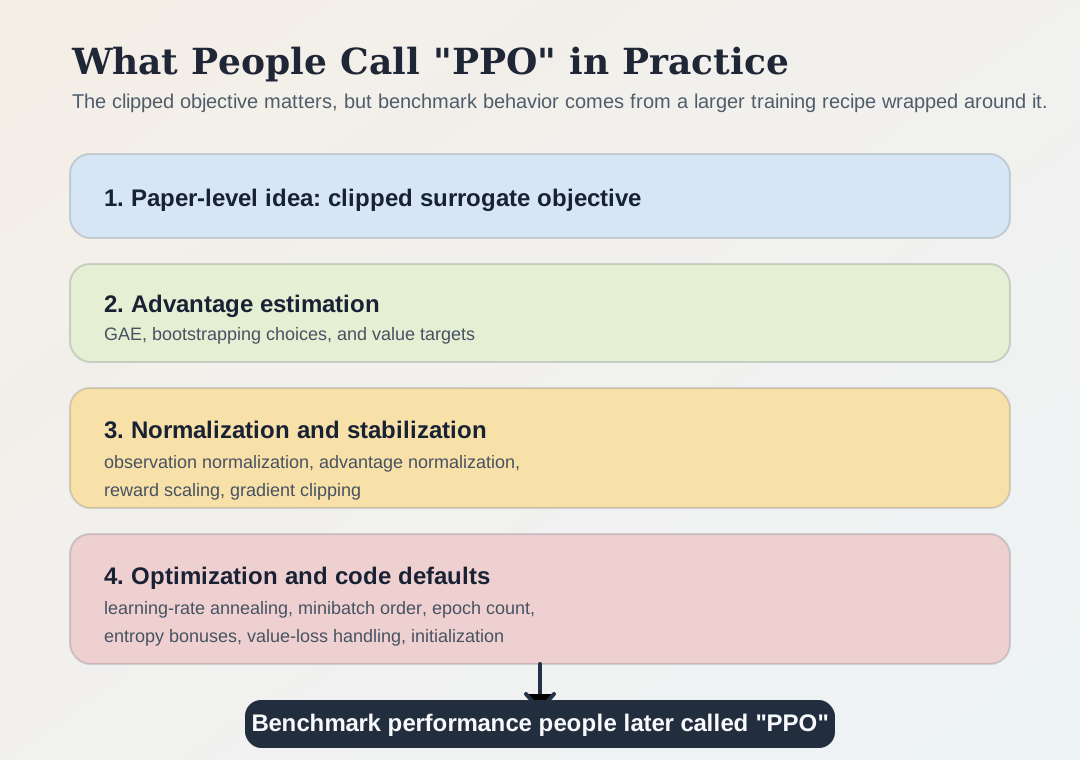
My short answer is this: PPO is not “just clip,” but the practical success of PPO is also not explained by clip alone. What people call PPO in code is usually a whole training recipe: clipped objective, GAE, normalization, learning-rate schedules, gradient clipping, value-loss handling, initialization choices, and a pile of implementation defaults that rarely make it into the one-line summary.
The clean mathematical story
The most famous PPO objective is the clipped surrogate:
where
The intuition is familiar: if the new policy puts too much more probability on an action than the old policy did, clipping removes the incentive to push the ratio even further. That acts like a soft trust-region mechanism. The original PPO paper sold this as a simpler alternative to TRPO: keep the spirit of conservative policy updates, but avoid second-order optimization and a hard KL-constrained step.
At this level, the story sounds almost embarrassingly simple. Replace a hard trust-region step with a clipped first-order surrogate, then do multiple minibatch epochs, and you get a method that is easy to code and works well in practice.
That is the part people summarize as “PPO is just clip.” And honestly, I understand why. If you only look at the paper-level abstraction, the delta from older policy-gradient methods does not look large enough to explain the whole mythology around PPO.
What people usually mean by “PPO”
This is where the discussion often goes wrong. In papers, people talk as if the object under discussion is the clipped objective. In real training code, the object under discussion is closer to a small software stack.
Why that summary is incomplete
The problem is that the PPO people usually run is not just the clipped objective in the paper. It is a system.
In practical implementations, PPO often includes many of the following:
- generalized advantage estimation (GAE),
- reward or return normalization,
- observation normalization,
- advantage normalization,
- learning-rate annealing,
- gradient clipping,
- value-loss clipping or tuned value-loss coefficients,
- entropy bonuses,
- orthogonal initialization,
- specific activation choices and network widths,
- careful minibatch shuffling and epoch counts,
- early stopping or monitoring via KL diagnostics.
If you strip many of those away and keep only the mathematical clipping term, you do not necessarily recover the PPO that became famous in benchmarks. That is the key point. The name stayed the same, but the effective method became much larger than the equation.
That is exactly why the paper Implementation Matters in Deep Policy Gradients: A Case Study on PPO and TRPO is so important. Engstrom et al. did the unglamorous but necessary work: they systematically separated the objective-level idea from the code-level decisions buried in reference implementations. Their conclusion was not merely that “details help a bit.” It was much stronger. A large fraction of PPO’s observed empirical advantage over TRPO could be attributed to implementation details rather than the clipped objective itself.
The key lesson from the PPO/TRPO case study
The central insight from the Implementation Matters paper is that deep RL algorithms are often underdescribed by their headline objective.
Researchers usually talk as if the meaningful comparison is:
- TRPO = trust-region method,
- PPO = clipped first-order method.
But in code, the comparison is more like:
- TRPO + one set of hidden defaults,
- PPO + another, usually more polished, set of hidden defaults.
Once the authors made those choices explicit and transferred useful implementation details across methods, the ranking changed. A carefully optimized TRPO variant could match or outperform standard PPO on some tasks. Likewise, clipping itself was not the sole source of stable updates. In some ablations, once other engineering choices were retained, removing clipping did not immediately destroy performance.
This is the uncomfortable but important result: the empirical comparison was never “pure TRPO versus pure PPO” in the clean mathematical sense people often imagine. It was partly a comparison between implementation bundles.
That does not mean clipping is useless. It means clipping was only one component in a larger training recipe.
Why clipping still matters
It would be an overreaction to jump from “clip is not everything” to “clip does nothing.”
The clipped objective still plays a real role. It changes the optimization landscape by preventing the policy ratio from being rewarded for moving too far away from the old policy in directions where the estimated advantage has the same sign. In effect, it discourages overly aggressive policy updates without forcing the optimizer to solve a constrained second-order problem.
That matters for at least three reasons.
1. It makes first-order training practical
TRPO’s trust-region update is elegant, but it requires a more complex optimization routine involving second-order information or approximations to it. PPO lets you stay inside the familiar stochastic-gradient training loop. That simplicity is not just cosmetic. It changes what is easy to implement, debug, and scale.
2. It gives a useful bias toward conservative updates
Even if clipping is not the only stabilizer, it is still a meaningful one. In noisy policy-gradient training, especially with imperfect advantage estimates, you want a mechanism that reduces the optimizer’s temptation to exploit local estimation error. Clipping provides such a bias.
3. It interacts well with the rest of the stack
This is the part people often miss. In deep RL, mechanisms are rarely important in isolation. Clipping, advantage normalization, epoch count, reward scaling, and architecture all interact. A component can look weaker when isolated than it does inside a well-tuned training pipeline.
So the right way to think about clip is not as a complete explanation of PPO, but as one stabilizing ingredient in a recipe whose performance depends heavily on the whole mixture.
The deeper point: “the algorithm” is often the codebase
This is the more uncomfortable conclusion, and in my view the one that generalizes far beyond PPO.
In deep learning and deep RL, we like to pretend that the algorithm is fully described by the equation in the paper. In reality, the paper often specifies the core optimization idea, while the codebase determines much of the empirical behavior.
For PPO, this means the object that won the benchmark race was not merely
but rather:
That is why saying “PPO is just a trick” is both wrong and directionally insightful.
- It is wrong because clipping really does encode a meaningful policy-update heuristic.
- It is insightful because the name PPO often hides how much of the result comes from the surrounding implementation stack.
If I had to phrase it more bluntly: people often argue about the wrong object. They argue about a neat paper objective, while the benchmark gains were produced by a much messier training system.
What this means for reading RL papers
The practical lesson is not to become cynical. It is to become more precise, and maybe a bit less romantic about paper equations.
When reading a paper that claims one policy-gradient method is better than another, you should ask at least four questions:
1. What is the actual objective-level novelty?
Is the paper changing the policy objective, the value-learning target, the sampling scheme, or only the trust-region approximation?
2. What implementation details are essential to the reported result?
If observation normalization, reward scaling, gradient clipping, or initialization are needed, they should be treated as part of the method’s effective definition, not as invisible defaults.
3. Are we comparing algorithms or codebases?
A fair comparison requires transferring strong engineering practices across baselines whenever possible.
4. What survives ablation?
If removing the headline trick leaves most of the gain intact, then the contribution may be elsewhere.
Why this discussion still matters today
This is not just an old MuJoCo argument. The same mistake shows up again and again.
The same pattern keeps returning in modern RL and RLHF:
- a paper introduces one elegant core idea,
- open-source implementations quietly add many stabilizers,
- the community starts referring to the whole package by the name of the headline trick,
- later, people forget which parts were mathematically central and which parts were engineering glue.
Once that happens, discourse becomes confused. Debates become “Is method X actually just trick Y?” when the real object under discussion is a full training system.
PPO became the canonical example because it is simple enough to describe in one equation and messy enough in practice to expose the gap between papers and implementations.
A better formulation of the question
So instead of asking,
“Is PPO just a clip trick?“
the better question is:
“How much of PPO’s practical success comes from clipping, and how much comes from the implementation package around it?”
That is a better question because it can actually be investigated experimentally. It also leads to a healthier research norm: treat implementation choices as first-class components of the method.
Bottom line
PPO is not merely a one-line trick. The clipped surrogate objective is a real idea, and it does change the character of policy optimization. But if we are being honest about what actually succeeded in practice, the empirical object called PPO is much larger than the clipping term alone.
If you only remember one sentence, it should be this:
PPO won not just because of clip, but because a simple objective was embedded inside a very effective implementation stack.
A compact comparison
| Question | Short answer |
|---|---|
| Is clipping the whole story of PPO? | No. |
| Is clipping irrelevant? | Also no. |
| Can implementation details account for a large share of PPO’s success? | Yes. |
| Can a well-implemented TRPO close the gap or even win on some tasks? | Yes, according to the implementation study. |
| What should practitioners learn from this? | Treat implementation choices as part of the algorithm, not as footnotes. |
References
- Schulman et al., Proximal Policy Optimization Algorithms, arXiv 2017.
https://arxiv.org/abs/1707.06347 - Engstrom et al., Implementation Matters in Deep Policy Gradients: A Case Study on PPO and TRPO, arXiv 2020.
https://arxiv.org/abs/2005.12729 - CleanRL repository, as an example of making implementation detail explicit in RL code.
https://github.com/vwxyzjn/cleanrl