verl, vLLM, and FlashAttention: How the Stack Actually Fits Together
These three names get mentioned together so often that people start talking as if they live at the same layer of the system. They do not.
That is the first thing to get straight.
- verl is a post-training framework for RL-style training.
- vLLM is an inference and serving engine that is very good at fast generation.
- FlashAttention is an attention kernel family that speeds up the attention computation itself.
If you only remember one sentence from this post, it should be this:
verl orchestrates the training loop, vLLM accelerates generation, and FlashAttention accelerates attention kernels.
That separation explains why all three often appear in the same environment, especially in PPO, GRPO, or other RLVR / RLHF-style pipelines. They are not redundant. They target different bottlenecks.
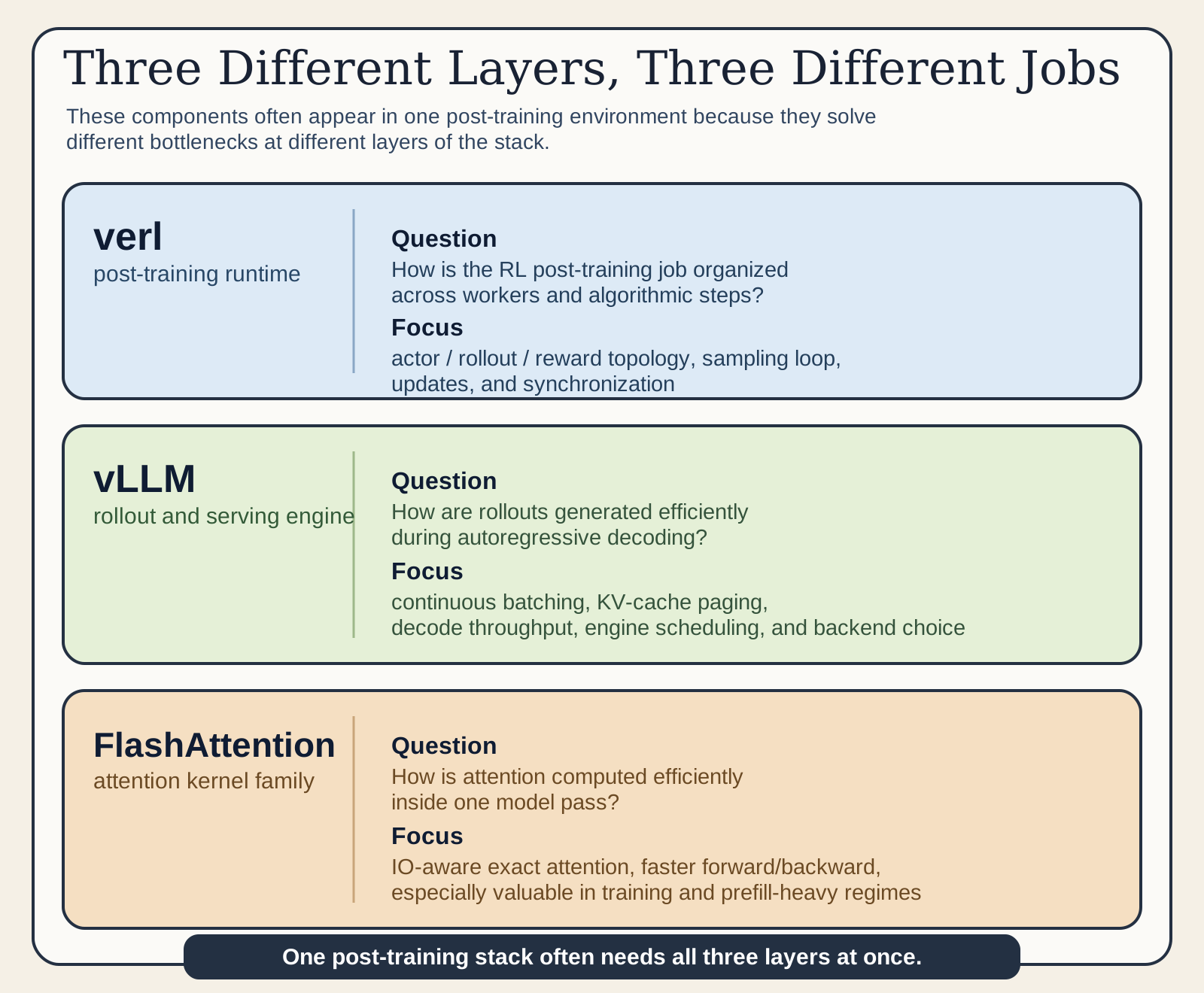
Figure 1. The three components sit at different layers. The confusion usually comes from seeing them in the same training script and assuming they solve the same problem.
1. Why these three names show up together
A modern LLM post-training loop usually has two expensive phases:
- rollout generation: sample responses from the current policy,
- parameter update: compute rewards, advantages, losses, and run forward/backward passes.
A useful first-order decomposition is
In practice, some of these terms can overlap, but the bottleneck logic is still the same.
- If generation is too slow, your GPUs sit idle waiting for samples.
- If training forward/backward is too slow, you generate samples quickly but cannot update efficiently.
- If coordination is poor, you waste time shuffling weights, trajectories, or cache state between workers.
That is exactly where the three components enter:
- verl tries to organize the whole loop,
- vLLM tries to reduce
T_rollout, - FlashAttention mainly tries to reduce the attention part of
T_update, and in some setups also part of prefill.
2. What verl actually is
The official verl documentation describes the stack as supporting FSDP for training and vLLM for rollout. That sentence is already enough to place verl correctly in the system.
verl is not an attention implementation and it is not a serving engine. It is the orchestration layer for post-training. In practical terms, that means it is responsible for things like:
- splitting work across actor, rollout, reference, reward, and trainer workers,
- managing data flow between sampling and learning,
- running PPO, GRPO, DAPO, and related recipes,
- coordinating distributed backends such as FSDP or Megatron-LM,
- deciding how the rollout engine is invoked and how weights are synchronized.
The right mental model is:
verl is the training runtime that decides who does what and when.
In a typical RL loop, verl will do something like this:
- load or shard the trainable actor model,
- launch rollout workers,
- send prompts to the rollout engine,
- collect generated responses,
- compute rewards and advantages,
- run the policy update,
- synchronize updated weights for the next round.
This is why people who only think about kernels often misread the stack. verl is not trying to beat FlashAttention at matrix math. It is trying to make the whole post-training pipeline usable and scalable.
3. What vLLM actually is
The official vLLM docs describe it as a fast inference and serving library, with speed coming from PagedAttention, continuous batching, CUDA/HIP graph execution, and other optimized kernels, including integration with FlashAttention and FlashInfer.
That wording matters.
vLLM is not just a wrapper around a model’s generate() method. It is an inference engine built around the observation that generation throughput is dominated by scheduling and KV-cache efficiency, not just raw GEMM speed.
Its two most important ideas are:
- efficient KV-cache management, especially through PagedAttention-style memory organization,
- continuous batching, so the engine keeps the GPU busy even when requests arrive at different times or have different output lengths.
In a verl pipeline, vLLM is usually there for one reason: sampling is expensive, and naive Hugging Face generation often wastes too much GPU time and memory.
So the clean role split is:
- verl says, “I need N rollouts from the current policy.”
- vLLM says, “I will generate them efficiently.”
That is why official verl docs explicitly talk about training with FSDP and rollout with vLLM as separate concerns.
4. What FlashAttention actually is
FlashAttention is a family of exact, IO-aware attention kernels. The original paper’s key contribution was not changing the semantics of attention, but reorganizing the computation so that it spends much less time moving intermediate tensors back and forth to high-bandwidth memory.
That distinction is important.
FlashAttention is not a new RL algorithm. It is not a serving engine. It is a lower-level kernel optimization for attention. In practice, that means:
- less memory traffic,
- better fusion of the attention pipeline,
- faster forward and backward attention,
- lower memory footprint than naive attention implementations.
FlashAttention matters especially when attention itself is a dominant cost, which is often true in:
- long-context training,
- large-batch training,
- high-throughput prefill,
- long-sequence policy updates in RL post-training.
So if you are running actor/reference/critic forward-backward passes during PPO or GRPO updates, FlashAttention often matters a lot even if vLLM is already handling generation.
5. The key distinction: prefill is not decode
A lot of confusion disappears once you separate prefill from decode.
For one request, rollout cost is roughly
These two phases behave very differently.
Prefill
During prefill, the model processes the full prompt. Query length is large, the attention computation is dense, and kernel efficiency matters a lot. This is a regime where FlashAttention-style kernels are very natural.
Decode
During decode, the model usually generates one new token at a time. Query length is tiny, but the key/value cache keeps growing. At this point, memory layout, KV-cache paging, scheduler behavior, and batching policy become much more important.
That is why you should not think of vLLM and FlashAttention as interchangeable.
- FlashAttention is very strong at making the attention kernel itself efficient.
- vLLM is very strong at making repeated autoregressive generation efficient as a serving system.
These are related, but not identical, problems.
6. Why vLLM is not just “FlashAttention for serving”
The official vLLM API docs are quite explicit here. vLLM has multiple attention backends, including:
flash_attn,flashinfer,triton_attn, which the docs describe as using PagedAttention and Triton prefix prefill.
That tells you two things.
First, vLLM is architected as a serving system that can choose among backends. It is not identical to any one kernel implementation.
Second, vLLM’s major contribution is not reducible to “use FlashAttention.” Its throughput gains also come from:
- request scheduling,
- continuous batching,
- KV-cache paging,
- memory reuse,
- engine-level execution strategies.
So when somebody says, “I already installed flash-attn, why do I still need vLLM?” the answer is straightforward:
Because
flash-attndoes not give you a rollout engine, a KV-cache scheduler, or high-throughput multi-request decoding.
And when somebody says, “If I use vLLM, do I no longer care about FlashAttention?” the answer is also straightforward:
No. You still care about fast attention kernels, especially for training and prefill-heavy workloads.
7. How the three components interact in a typical RL loop
A common training iteration looks like this:
- verl holds the training logic and distributed worker graph.
- The current actor weights are made available to the rollout engine.
- vLLM generates samples from prompts at high throughput.
- The trajectories return to verl.
- verl computes rewards, baselines, and advantages.
- The trainable actor/reference components run forward and backward passes.
- Those model passes may benefit directly from FlashAttention in the training stack.
- The next updated policy is synchronized, and the loop repeats.
If you want a bottleneck view:
| Bottleneck | Main tool that addresses it | Why |
|---|---|---|
| coordinating RL post-training workers | verl | it is the orchestration framework |
| generating many rollouts fast | vLLM | it is the inference engine |
| making attention forward/backward cheaper | FlashAttention | it is the kernel optimization |
That table is the shortest correct answer to the whole topic.
8. Why people often install all three in one environment
This is where practical systems work enters.
In a real post-training environment, you often need:
- one set of dependencies for distributed training,
- one set for high-throughput rollout generation,
- one set for optimized kernels.
That is why the official verl upgrade guide for vLLM 0.8+ literally shows all three ideas in one installation path:
- install
verl, - install
vllm==0.8.3, - install
flash-attn.
People sometimes misread that as evidence that the three libraries do the same job. It is the opposite. They are installed together because they solve different parts of the same training stack.
9. The most common misunderstanding in practice
The most common misunderstanding is this:
“If generation is slow, I should think about FlashAttention first.”
Usually that is the wrong first instinct.
If the slow part is autoregressive rollout throughput, especially under many requests or long decode chains, you should first think about:
- vLLM engine configuration,
- batching behavior,
- KV-cache pressure,
- rollout parallelism,
- weight synchronization overhead.
If the slow part is training forward/backward or long-sequence prefill, then FlashAttention becomes a more natural first suspect.
That is why diagnosis has to be layered.
| Symptom | First place to look |
|---|---|
| rollout sampling is too slow | vLLM engine, batching, KV cache, scheduling |
| PPO/GRPO update step is too slow | training backend, FlashAttention, model sharding |
| whole pipeline has poor overlap | verl worker topology and sync pattern |
flash-attn build or ABI errors | CUDA / PyTorch / GPU architecture compatibility |
| vLLM rollout crashes after version bump | vLLM-verl integration and backend compatibility |
10. Where things actually break
A lot of pain in this stack is not conceptual. It is operational.
FlashAttention breakages
flash-attn is a compiled extension. So problems often come from:
- mismatched CUDA version,
- mismatched PyTorch ABI,
- unsupported GPU architecture,
- build isolation / compiler issues.
When flash-attn fails, the symptom often shows up as import failures, undefined symbols, build failures, or unexpected fallback behavior.
vLLM breakages
vLLM issues often look different:
- rollout engine initialization failures,
- KV-cache allocation problems,
- version mismatches between engine APIs and the framework calling them,
- distributed inference instability after an upgrade.
verl breakages
verl problems often show up one level higher:
- bad worker placement,
- poor overlap between rollout and update,
- synchronization overhead,
- reference/reward/actor topology mistakes,
- configuration mismatches across training and rollout workers.
That is why debugging by package name alone is sloppy. You need to debug by layer of responsibility.
11. A better way to think about the stack
The cleanest formulation I know is this:
- verl answers: how is the RL post-training job organized?
- vLLM answers: how are tokens generated efficiently at serving time?
- FlashAttention answers: how is attention computed efficiently inside one model pass?
Those are different questions.
Once you phrase it that way, the architecture stops being mysterious.
12. Bottom line
If you are building a post-training system and you see verl + vLLM + flash-attn in the same environment, do not read that as duplication. Read it as layering.
- Use verl to orchestrate the RL loop and distributed workers.
- Use vLLM when rollout generation is your serving bottleneck.
- Use FlashAttention when attention kernels are your compute and memory bottleneck.
The short version is:
verl is the training runtime, vLLM is the generation engine, and FlashAttention is the kernel.
That is the right abstraction boundary, and most confusion comes from crossing it.
References
- verl documentation, Upgrading to vLLM >= 0.8.
https://verl.readthedocs.io/en/latest/README_vllm0.8.html - Sheng et al., HybridFlow: A Flexible and Efficient RLHF Framework, arXiv 2024.
https://arxiv.org/abs/2409.19256 - vLLM documentation.
https://docs.vllm.ai/ - Kwon et al., Efficient Memory Management for Large Language Model Serving with PagedAttention, arXiv 2023.
https://arxiv.org/abs/2309.06180 - Dao et al., FlashAttention: Fast and Memory-Efficient Exact Attention with IO-Awareness, NeurIPS 2022.
https://arxiv.org/abs/2205.14135 - Dao, FlashAttention-2: Faster Attention with Better Parallelism and Work Partitioning, ICLR 2024.
https://arxiv.org/abs/2307.08691